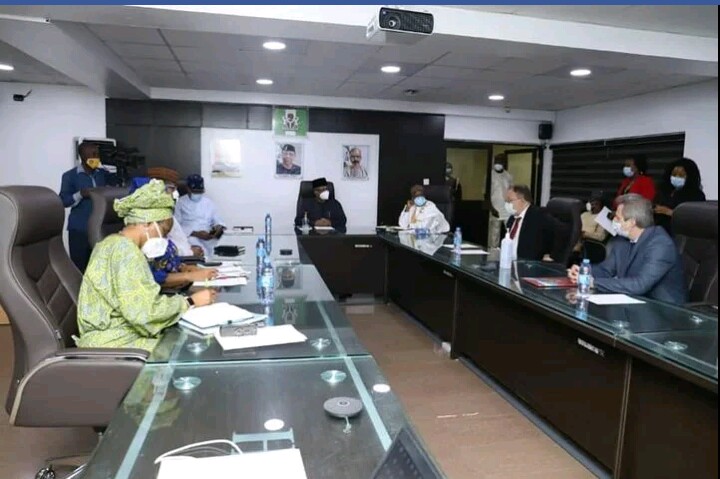
The Minister of State for Health, Olorunnumbe Mamora, has stated that the Federal Government has paid up to N20bn as COVID-19 inducement allowance to doctors and health workers in the country.
Nigerian resident doctors began their second strike of the year over pay and working conditions amid the spread of the new coronavirus.
The strike began on Monday, and includes 16,000 resident doctors out of a total of 42,000 doctors in the country, Dr. Aliyu Sokomba, President of the National Association of Resident Doctors said;
“It is an indefinite strike until issues are resolved,” he said. “All resident doctors at the COVID-19 centres have joined the strike.”
The minister of state appeared as a guest on Channels TV, stating that it would be unfair for the doctors to claim they haven’t received any thing as COVID-19 allowance. According to him, the Federal government has so far disbursed N20 billion as COVID-19 allowance. Mamora said;
“ We have been able to pay the COVID-19 inducement allowance because we had to suspend the hazard allowance for this period so that we can go into renegotiation after.
“We are now paying starting from 50 per cent of the basic of the workers depending on where the point of operation is. We were able to pay April and May in full. Part payment of June has been made and it’s because of the economic situation and these funds have to be sourced for one way or the other.
We’ve been able to disbursed close to N20bn and I repeat close to 20bn. So, to now say nothing has been done, that is not true.”
Addressing the grievance of the doctors over the insurance package for health workers who die in the line of duty, Mamora said;
“Every worker in the Federal Civil Service is entitled to the Group Life Insurance Scheme which is domiciled in the office of the head of Civil Service of the Federation.
“We discussed this in our previous engagements with the doctors and we did say that you need to come up with this information and all the relevant officials, particularly in the office of the head of Civil Service of the Federation were present so that they (doctors) will know who to direct all these things to.
“What we just do in the ministry of health is the supervision of the process. So, when a health worker dies and he was an employee of the Federal Government, the information comes to us, goes to our Human Resources Directorate and it is processed. Ours is to do a follow-up but the office of the head of Civil Service will get these things done because they are the one that interface with insurance companies because it is a group of insurance companies that manage this process.
“But what we have discovered is that some of the time, the appropriate information is not made available.
” For example, we have asked the various federal tertiary hospitals to come up with their nominal role so we know who is on that list and stands to benefit in the event that death, unfortunately, happens. We made that clear and the doctors said they now understand better.”
Nigeria, Africa’s most populous nation, has a total of 55,160 confirmed coronavirus infections and 1,061 deaths.
Resident doctors are medical school graduates training as specialists. They are pivotal to frontline healthcare in Nigeria as they dominate the emergency wards in its hospitals.
The group last went on strike in June, demanding better benefits and more protective equipment for battling the coronavirus. They are still demanding, among other things, life insurance and hazard allowance.
In a statement, Minister of Labour Chris Ngige called on the doctors to suspend the strike.
“All parties are enjoined not to employ arm-twisting methods to intimidate or foist a state of helplessness on the other party,” he said.
The statement said the government had spent 20 billion naira ($52.56 million) on hazard allowances for healthcare workers in April, May and June, and had met the bulk of the doctors’ demands.
 Streetwisenetwork