Joe Biden winnowed a large list of candidates to four finalists before settling on Kamala Harris, in a process shaped by questions of loyalty.
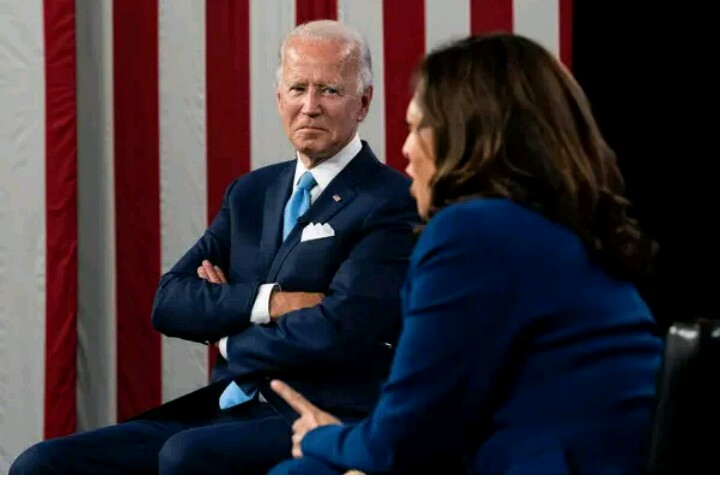
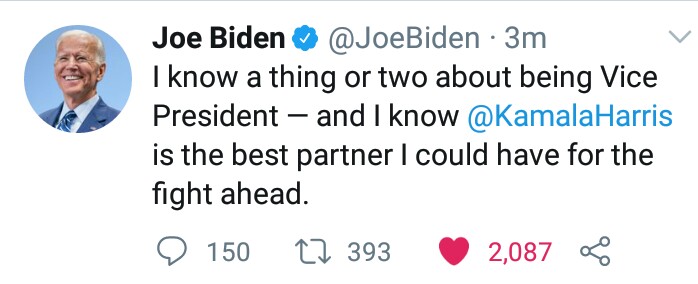
In Biden’s recent tweet, the former vice president and the presidential candidate for the democrats in the forthcoming US election has stated clearly that Kamala Harris is the best partner he could have for the battle ahead.
Refer to his tweet below:
It was early in Joseph R. Biden Jr. ’s vice-presidential search when he asked his advisers a sensitive question about Senator Kamala Harris. He kept hearing so much private criticism of her from other California Democrats, he wanted to know: Is she simply unpopular in her home state?
Advisers assured Mr. Biden that was not the case: Ms. Harris had her share of Democratic rivals and detractors in the factional world of California politics , but among regular voters her standing was solid.
Mr. Biden’s query, and the quiet attacks that prompted it, helped begin a delicate audition for Ms. Harris that has never before been revealed in depth. She faced daunting obstacles, including an array of strong competitors, unease about her within the Biden family and bitter feuds from California and the 2020 primary season that exploded anew.
Though Ms. Harris was seen from the start as a front-runner, Mr. Biden did not begin the process with a favorite in mind, and he settled on Ms. Harris only after an exhaustive review that forged new political alliances, deepened existing rivalries and further elevated a cohort of women as leaders in their party.
Ms. Harris was one of four finalists for the job, along with Senator
Elizabeth Warren of Massachusetts, Gov. Gretchen Whitmer of Michigan and Susan E. Rice , the former national security adviser.
But in the eyes of Mr. Biden and his advisers, Ms. Harris alone covered every one of their essential political needs.
Mr. Biden’s instincts were not destined to lead him to Ms. Harris: He and members of his family had long expressed discomfort with the way she attacked him at a Democratic primary debate, and his political advisers remembered well the seemingly constant dysfunction of her presidential campaign.
There was a particular distrust in the Biden camp for the sharp-elbowed California operatives with whom Ms. Harris has long surrounded herself, fearing that they might seek to undermine Mr. Biden in office to clear the way for Ms. Harris in 2024.
Yet no other candidate scored as highly with Mr. Biden’s selection committee on so many of their core criteria for choosing a running mate, including her ability to help Mr. Biden win in November, her strength as a debater, her qualifications for governing and the racial diversity she would bring to the ticket. No other candidate seemed to match the political moment better.
Of all the interviews conducted, only Ms. Harris’s burst into public view as a matter of controversy, when one of the members of the search team,
former Senator Christopher J. Dodd of Connecticut, told associates that he had been dismayed by what he regarded as an inadequately contrite answer by Ms. Harris about her searing denunciation of Mr. Biden at a Democratic primary debate in June 2019.
Ms. Harris recognized from the start that her attack on Mr. Biden — for having worked with segregationist senators to oppose school busing — was a liability for her as a potential running mate, and she spent considerable time reaching out to Biden allies to seek their advice about how she should approach the former vice president.
But Ms. Harris’s interviews covered far more ground than just a single debate, and like the other candidates, Ms. Harris faced intensive scrutiny of her personal and political history. Biden advisers asked, for instance, about contributions she received as state attorney general from Steven Mnuchin, President Trump’s Treasury secretary, who at the time was running a bank, OneWest, that was accused of violating foreclosure laws. Ms. Harris declined to pursue prosecutions in the case.
Ms. Harris has said consistently that political donations played no role in her legal decisions as attorney general.
There was broad agreement among his advisers that Mr. Biden should
choose a woman of color, though Mr. Biden remained drawn to both Ms. Whitmer and Ms. Warren. There was unanimity that he needed someone with unimpeachable governing qualifications: Private Democratic polling and focus groups found that voters were keenly aware of Mr. Biden’s advanced age, and the possibility that his running mate could become president by medical rather than electoral means.
In some Democratic focus groups, too, voters expressed skepticism that Biden would choose a candidate with strong qualifications: By making gender a nonnegotiable requirement, they wondered, was Mr. Biden indicating he cared more about identity than experience? To Democratic strategists who have studied the obstacles for women in politics, the presumption that there would be better credentialed men available was not a surprising concern.
At least two women besides Ms. Harris seemed capable of matching all those criteria: Ms. Rice and Ms. Bass, the former speaker of the California Assembly.
Ms. Rice benefited from her close relationship with Mr. Biden and a concerted push on her behalf by other alumni of the Obama administration, though not the former president himself. But she had never been a candidate for office before, and Mr. Biden was more familiar than most with how much of a vice president’s time is typically spent on political errands. He concluded it would be too risky to pick a running mate who had never been on the ballot.
Ms. Bass emerged late in the process as a formidable rival to Ms. Harris. Though she was little known outside California and Congress, Ms. Bass impressed the vetting committee, and Mr. Dodd took steps to elevate her during the search process. Several people close to Mr. Biden sang her praises to the former vice president, including Ms. Pelosi and Senator Chris Coons of Delaware.
But Ms. Bass knew she had political liabilities, according to people who spoke with her directly throughout the process. She had visited Cuba repeatedly as a young woman and at times had made somewhat admiring comments about the government of Fidel Castro. She discussed those matters openly with the vetting committee, recognizing how politically damaging they could be in the crucial swing state of Florida, with its large and politically active immigrant communities from repressive Latin American countries.
Mr. Biden was aware of Ms. Bass’s Castro-era baggage well before it spilled into the news media. He told one longtime friend that her history with Cuba could cause political headaches, though to other people he suggested he did not see it as politically disqualifying — he intended to win the election in the Midwest, Mr. Biden told them, even if he were to fall short in Florida.
For Mr. Biden, Ms. Bass’s greatest shortcoming as a candidate was simpler: He did not really know her, and the coronavirus pandemic made it difficult to establish a close personal connection in short order.
Mr. Biden and his top aides were cognizant of the sniping, but advisers stressed to the former vice president that there was no way of knowing if it was authorized by Ms. Harris or was being done on a freelance basis — and that they shouldn’t let it color their decision.
To Ms. Harris, he placed a video call and asked, “You ready to go to work?”
No candidate scored as highly as Senator Kamala Harris on the Biden campaign’s core criteria for a running mate, including her strength as a debater and ability to help him win the White House.
 Streetwisenetwork