Gun-toting members of the Boogaloo movement are showing up at protests.
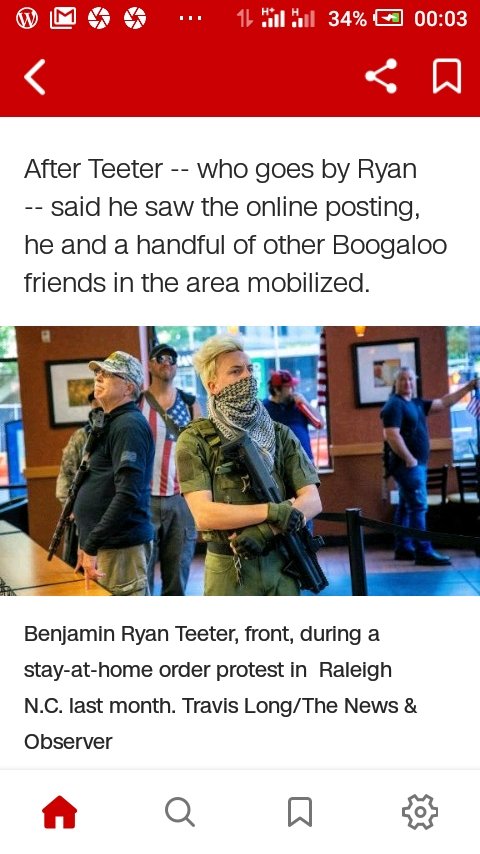
Benjamin Ryan Teeter was at his home in Hampstead, N.C., when the call to action came. It was an alert from the heart of the raging protests in Minneapolis, posted on an online forum by a fellow member of the Boogaloo movement, a loosely knit group of heavily armed, anti-government extremists.
The “alert” was from a man who had a run-in with the Minneapolis police while on the frontline of the police-brutality protests set off by the death of George Floyd.
“He caught mace to the face,” said Teeter, and “put out a national notice to our network.”
After Teeter — who goes by Ryan — said he saw the online posting, he and a handful of other Boogaloo friends in the area mobilized.
They grabbed their guns — mostly assault rifles — hopped into their vehicles, and made the 18-hour trek to Minneapolis.
The Boogaloos are an emerging incarnation of extremism that seems to defy easy categorization. They are yet another confounding factor in the ongoing effort among local, state and federal officials to puzzle out the political sympathies of the agitators showing up to the mostly peaceful George Floyd rallies who have destroyed property, looted businesses, or — in the case of the Boogaloos who descended on Minneapolis — walked around the streets with assault rifles.
Boogaloo members appear to hold conflicting ideological views with some identifying as anarchists and others rejecting formal titles. Some pockets of the group have espoused white supremacy while others reject it. But they have at least two things in common: an affinity for toting around guns in public and a “boogaloo” rallying cry, which is commonly viewed as code for another US civil war.
Megan Squire, a computer science professor at Elon University in North Carolina who monitors online extremism, said the movement started in obscure online platforms.
It “is now growing on mainstream platforms, and in this moment of protest it is starting to move offline,” she said. “It resembles the militia movement that came before it, which has been well documented as a force for promoting violence.”
Teeter, in an interview with CNN, said he identifies as an anarchist. His mission in Minneapolis, he said, was to protect protesters from police abuse and white supremacists, whom he deplores.
“If people are going to initiate deadly force against us, we need to be willing and able to initiate deadly force in return,” Teeter, 22, said.
Despite the presence of Teeter, and he said a dozen or so of his compatriots, federal, state and local officials have put forth little evidence so far to suggest widespread organization and mobilization by any one ideological group.
A CNN review of the backgrounds of those arrested during the first three days of protests in Minneapolis did not surface any obvious links to known organizations.
Some police said they suspect that much of the rioting and looting was perpetrated not by ideological extremists, but smaller groups of criminal opportunists seeking to profit by stealing merchandise.
“These are straight up criminals. These are not protestors,” said one high-ranking LAPD official. In Los Angeles, he said, roving bands of thieves drove around in cars and communicated by cellphone, identifying businesses to loot.
Still, there are some documented reports of group-affiliated individuals from the left and right of the extremist spectrum mingling amid the less organized.
Gun-toting Boogaloo members have appeared at George Floyd protests in Minneapolis, Salt Lake City, Dallas, Atlanta and elsewhere, according to The Washington Post.
Known for sporting Hawaiian shirts and arriving to public protests heavily armed, the decentralized Boogaloo movement — sometimes referred to as the “Boogaloo Bois” — is often associated with the far-right.
But it is far from a cohesive group, said J.J. MacNab, a fellow at George Washington University who studies anti-government extremism.
“While there are pockets of white supremacist Boogaloos, the younger and bigger groups are generally not,” she said in a recent Twitter thread. “While there are Boogaloos that support police, the younger and bigger groups detest them. While there are Boogaloos that want to discredit protests angry at the murder of a black man, there are younger Boogaloos that are incensed by the murder and want to join the protests.”
MacNab added that such internal divisions don’t always play out according to age.
Heavily armed extremist movement gains traction..
Read more: https://www.cnn.com/2020/06/03/us/boogaloo-extremist-protests-invs/index.html
 Streetwisenetwork